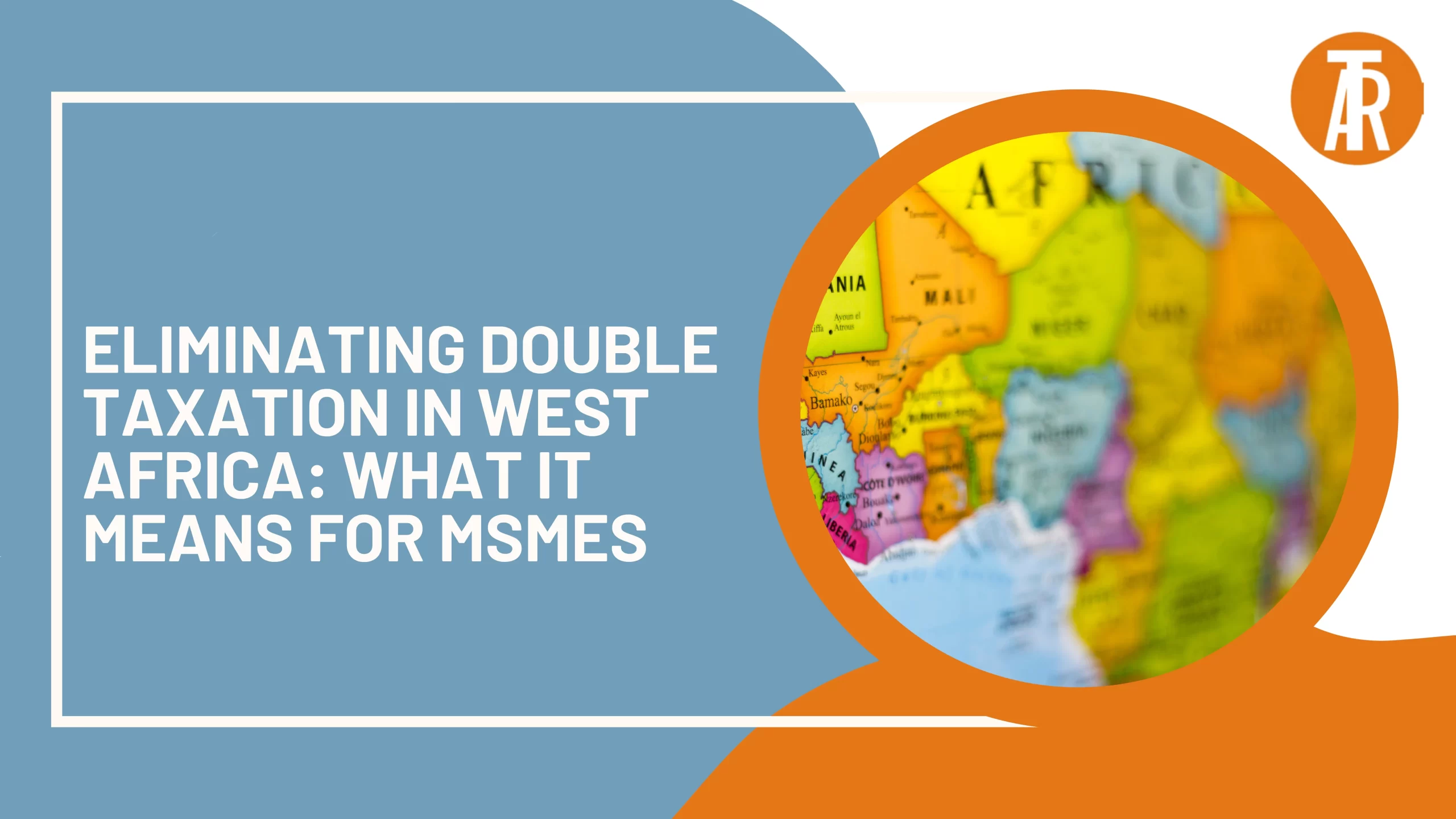
Eliminating Double Taxation in West Africa. For many Nigerian MSMEs expanding into Ghana, Benin Republic, Togo, or Côte d’Ivoire, growth comes with an unexpected challenge; Paying tax twice on the same income.
This is one of the biggest silent threats to small business profitability in West Africa.
Fortunately, the ECOWAS Double Taxation Framework, implemented in Nigeria through the 2023 Order , was designed to solve this exact problem.
But here is the reality:
- Many MSMEs are not aware of it
- Many are not applying it
- Many are losing money because of it
This article explains what eliminating double taxation means for MSMEs—and how to turn it into a strategic advantage.
Eliminating Double Taxation in West Africa: What Is Double Taxation?
Double taxation occurs when:
- You earn income in another country
- That country taxes you
- Nigeria also taxes the same income
Result: You pay two taxes on one income
Example (Relatable MSME Scenario)
A Nigerian fashion business sells to customers in Ghana:
- Ghana may tax the income (because customers are there)
- Nigeria taxes the same income (because the business is Nigerian)
Without protection, profit is reduced significantly.
How ECOWAS Eliminates Double Taxation
The ECOWAS framework ensures that:
- Income is taxed once
- Tax rights are shared fairly between countries
- Businesses are protected from over-taxation
Two Key Methods Used
1. Tax Credit Method
- Tax paid in Ghana is credited in Nigeria
2. Exemption Method
- Income taxed abroad may not be taxed again in Nigeria
This ensures MSMEs do not suffer duplicate tax burden.
Why This Is Critical for MSMEs
Large companies can absorb tax inefficiencies.
MSMEs cannot.
Impact Without Treaty Benefits
- Reduced profit margins
- Cash flow problems
- Pricing disadvantages
- Growth limitations
Impact With Treaty Benefits
- Higher retained earnings
- Better pricing competitiveness
- Easier regional expansion
- Stronger financial stability
The Most Important Rule MSMEs Must Understand
Permanent Establishment (PE)
This determines whether you are taxable in another country.
What Counts as a Permanent Establishment?
- Office or shop
- Warehouse
- Branch
- Factory
- Construction project (over 6 months)
Simple Rule
| Situation | Tax Outcome |
| No physical presence | Taxed only in Nigeria |
| Physical presence exists | Taxed in that country |
This is where many MSMEs make costly mistakes.
Practical Scenarios for MSMEs
Scenario 1: Selling Online Across Borders
A Nigerian digital service provider sells to Senegal:
- No office in Senegal. Taxed only in Nigeria
Scenario 2: Opening a Subsidiary in Ghana
A small logistics company opens an office in Accra:
- Ghana taxes profits generated there
- Nigeria gives tax credit
No double taxation
Scenario 3: Receiving Payments from Abroad
An MSME receives interest or dividends:
- Withholding tax is capped (max 10%). Reduced tax burden
Where MSMEs Lose Money (Common Errors)
Many MSMEs unknowingly overpay tax due to:
- Not claiming treaty benefits
- Paying full withholding tax without reduction
- Ignoring cross-border tax rules
- Poor record keeping
- Not seeking professional advice
These mistakes can cost millions over time
How MSMEs Can Start Benefiting Immediately
Step 1: Understand your business structure
- Where do you operate?
- Where is your income generated?
Step 2: Identify cross-border transactions
- Sales
- Services
- Investments
Step 3: Check for Permanent Establishment
- Do you have a physical presence abroad?
Step 4: Apply treaty benefits
- Reduced withholding tax
- Tax credits
Step 5: Keep proper documentation
- Contracts
- Invoices
- Payment records
Strategic Advantage for Smart MSMEs
MSMEs that understand these rules can:
- Expand faster into West Africa
- Compete with larger companies
- Reduce tax costs legally
- Increase profitability
The Bigger Picture: MSMEs and AfCFTA
The elimination of double taxation supports:
- Regional trade
- Business mobility
- Economic integration
MSMEs are at the center of this transformation.
Final Insight: This Is Not Just Tax—It Is Survival
For MSMEs, tax is not just a compliance issue—it is:
A profitability and growth strategy
Those who understand it:
- Scale faster
- Retain more profit
- Avoid unnecessary financial pressure
Those who don’t:
- Pay more than necessary
- Struggle with expansion
- Face compliance risks
Conclusion: Turn Knowledge into Profit
Eliminating double taxation is one of the most powerful tools available to MSMEs in West Africa today.
The question is:
Are you using it—or losing money because you are not?
Stay Ahead with Africataxreview
Follow for:
- Practical tax insights
- MSME-focused strategies
- Real-life case studies