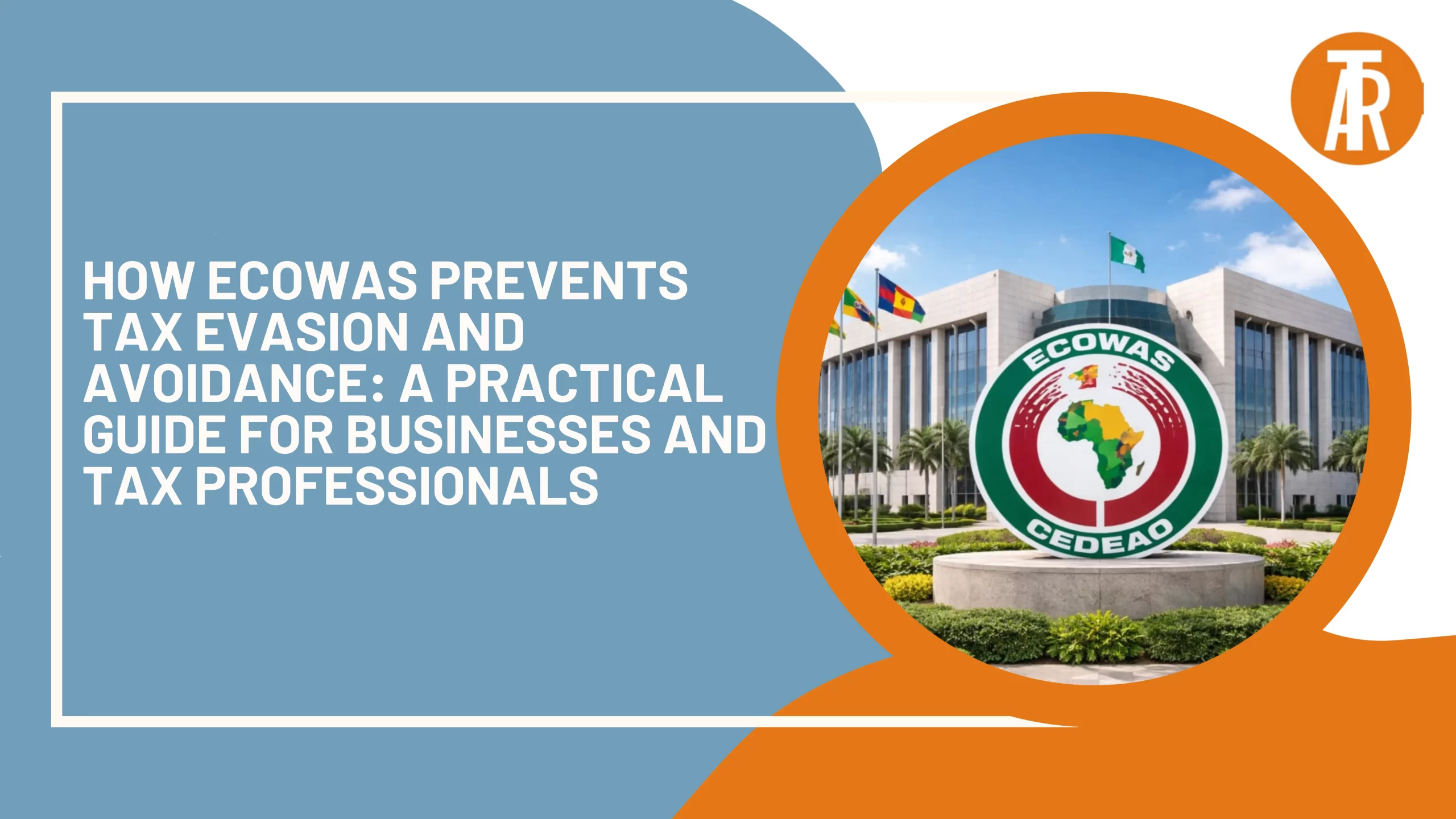
How ECOWAS Prevents Tax Evasion and Avoidance. Across West Africa, governments are losing billions annually—not because taxes are too low, but because:
Taxes are being avoided or evaded through complex cross-border structures.
From profit shifting to artificial transactions, businesses sometimes exploit gaps between national tax systems.
To address this, the ECOWAS Double Taxation Framework, implemented in Nigeria through the 2023 Order , introduces coordinated rules to:
- Prevent tax evasion
- Curb aggressive tax avoidance
- Promote transparency and fairness
This article explains how ECOWAS tackles these risks—and what it means for your business.
Understanding the Problem: Tax Evasion vs Tax Avoidance
Before exploring the solutions, it is important to distinguish:
Tax Evasion (Illegal)
- Deliberate non-payment of tax
- Concealment of income
- False declarations
Tax Avoidance (Legal, But Must not be Abusive)
- Using loopholes to reduce tax liability
- Artificial structuring of transactions
- Profit shifting across jurisdictions
👉 The ECOWAS framework targets both, especially where avoidance becomes abusive.
Why ECOWAS Had to Act
Without coordination:
- Businesses exploit differences between tax systems
- Income escapes taxation or is taxed minimally
- Governments lose revenue
- Honest businesses are disadvantaged
👉 ECOWAS introduced a harmonized framework to close these gaps.
How ECOWAS Prevents Tax Evasion and Avoidance (Key Mechanism)
1. The Associated Enterprises Rule (Anti-Abuse Core)
This rule ensures:
Transactions between related companies must reflect market conditions.
How It Prevents Abuse
- Stops artificial pricing
- Prevents profit shifting
- Ensures fair profit allocation
👉 Tax authorities can adjust transactions that are not at arm’s length.
2. Permanent Establishment (PE) Rules
PE rules determine:
When a foreign business becomes taxable in another country.
How It Prevents Abuse
- Stops businesses from avoiding tax by claiming “no presence”
- Captures economic activity within a country
👉 Even indirect presence (e.g., agents) can create tax liability.
3. Withholding Tax (WHT) Controls
Cross-border payments such as:
- Dividends
- Interest
- Royalties
Are subject to withholding tax.
How It Prevents Abuse
- Ensures tax is collected at source
- Reduces risk of non-reporting
👉 ECOWAS also caps rates to balance fairness and efficiency.
4. Exchange of Information Between Countries
Tax authorities can:
Share information across ECOWAS member states.
How It Prevents Abuse
- Detects hidden income
- Tracks cross-border transactions
- Identifies inconsistencies
👉 This reduces secrecy and increases transparency.
5. Elimination of Double Non-Taxation
The framework ensures:
Income is taxed at least once.
How It Prevents Abuse
- Prevents income from escaping taxation entirely
- Closes gaps between countries
👉 This is a major global tax policy objective.
6. Beneficial Ownership Requirement
To access treaty benefits:
The recipient must be the true owner of the income
How It Prevents Abuse
- Stops use of shell companies
- Prevents treaty shopping
👉 Ensures substance over form.
7. Dispute Resolution Mechanisms
The ECOWAS framework provides:
- Structured processes for resolving tax disputes
How It Prevents Abuse
- Reduces arbitrary assessments
- Ensures fairness between countries
👉 Protects both taxpayers and governments.
Real-Life Examples of Tax Abuse (And How ECOWAS Addresses Them)
Example 1: Profit Shifting
A company shifts profits to a low-tax country through artificial pricing:
👉 Solution: Associated Enterprises Rule adjusts pricing
Example 2: Hidden Presence
A company operates through agents but claims no presence:
👉 Solution: PE rules establish tax liability
Example 3: Treaty Shopping
A company routes income through another country to reduce tax:
👉 Solution: Beneficial ownership requirement
Example 4: Undeclared Cross-Border Income
A business earns income abroad but does not report it:
👉 Solution: Exchange of information
Implications for Nigerian Businesses
Businesses must now:
✔ Ensure transparency in transactions
✔ Maintain proper documentation
✔ Align pricing with market standards
✔ Understand cross-border tax obligations
👉 The era of aggressive tax planning without substance is ending.
Common Mistakes Businesses Must Avoid
❌ Using artificial structures
❌ Ignoring transfer pricing rules
❌ Poor documentation
❌ Not understanding PE exposure
❌ Misusing treaty benefits
👉 These can lead to audits, penalties, and reputational damage.
Strategic Advantage for Compliant Businesses
Businesses that comply with ECOWAS rules can:
- Avoid penalties and disputes
- Build credibility with tax authorities
- Expand confidently across West Africa
- Maintain sustainable profitability
Opportunities for Tax Professionals
This evolving framework creates opportunities in:
- Tax advisory
- Compliance support
- Transfer pricing
- Audit defense
- Cross-border structuring
Final Insight: Transparency Is the New Currency
The key shift in taxation is this:
- From secrecy to transparency
- From aggressive avoidance to structured compliance
Conclusion: A Stronger, Fairer Tax System in West Africa
The ECOWAS framework represents a major step toward:
- Fair taxation
- Regional cooperation
- Sustainable economic growth
The Real Question
Is your business aligned with this new reality—or still operating under outdated tax strategies?
Call to Action
If your business operates across ECOWAS:
- You may be exposed to tax risks
- You may need to review your structure
- You may require compliance support
Stay Ahead with Africataxreview
Follow for:
- African tax insights
- Cross-border strategies
- Real-life tax case studies
Olatunji Abdulrazaq CNA, ACTI, ACIArb(UK)
Founder/CEO,Taxmobile.Online