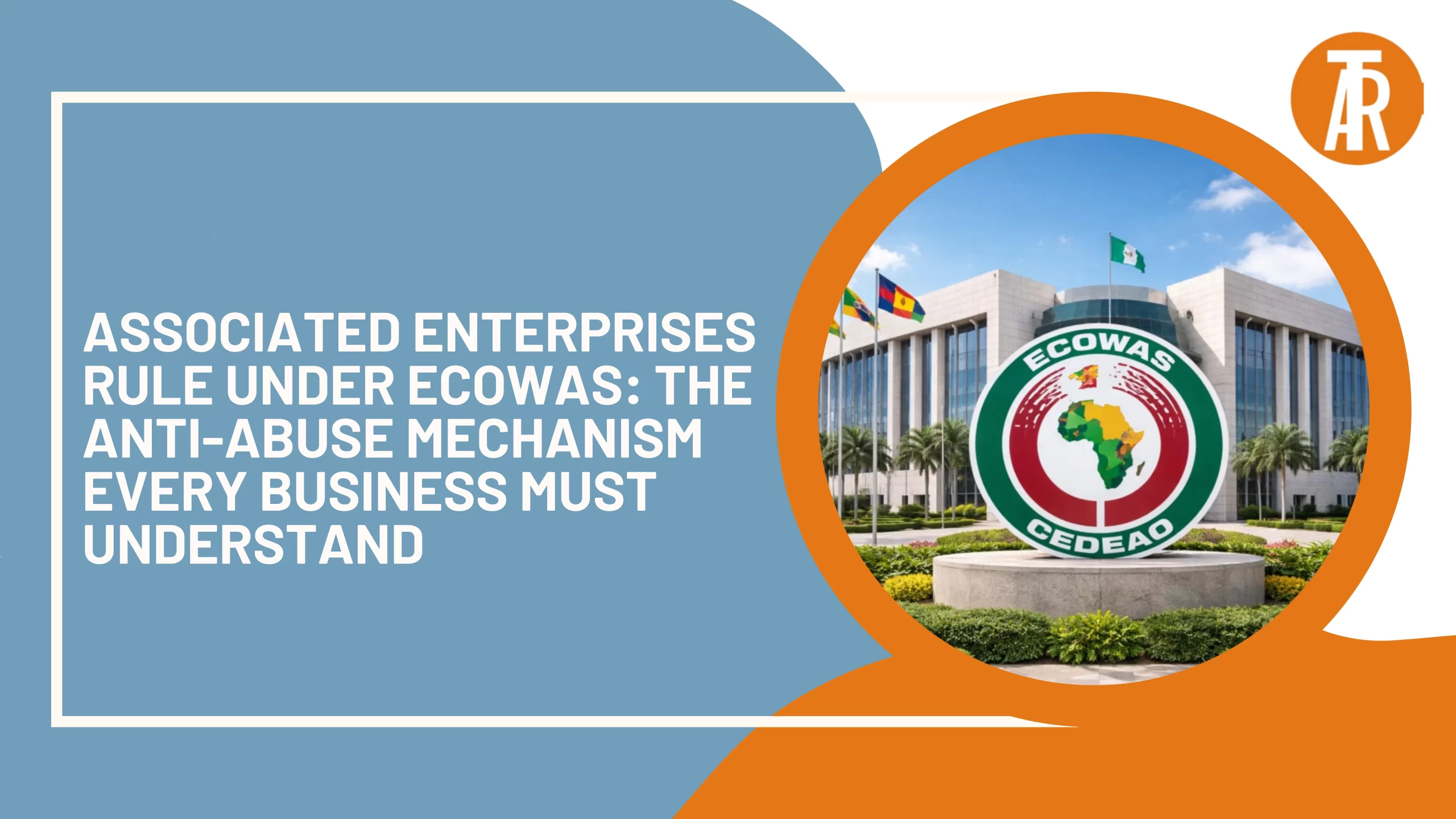
Associated Enterprises Rule Under ECOWAS. As businesses expand across ECOWAS countries, many adopt group structures:
- Parent companies and subsidiaries
- Sister companies across jurisdictions
- Shared services and centralized management
These structures are legitimate—but they come with a major risk:
The possibility of manipulating transactions to reduce tax.
To address this, the ECOWAS framework introduces the Associated Enterprises Rule, a powerful anti-abuse mechanism designed to ensure fairness in taxation.
This article explains how the rule works—and why it is critical for Nigerian businesses.
Associated Enterprises Rule Under ECOWAS: What Are Associated Enterprises?
Two companies are considered associated enterprises when:
- One company controls the other, or
- Both companies are under common control
Forms of Control
Control may exist through:
- Shareholding (direct or indirect)
- Management influence
- Financial dependence
- Contractual arrangements
This means the relationship goes beyond ownership—it includes economic influence.
Why the Rule Exists
The Associated Enterprises Rule is designed to:
- Prevent profit shifting
- Ensure fair taxation across countries
- Stop artificial arrangements
- Promote transparency
The Core Concern
Without this rule, businesses could:
- Shift profits to low-tax jurisdictions
- Inflate or deflate prices artificially
- Reduce taxable income in high-tax countries
This would undermine tax systems across ECOWAS.
The Core Principle: Arm’s Length Standard
The rule is built on one key principle:
Transactions between related companies must be conducted as if they were between independent parties.
What This Means
- Prices must reflect market conditions
- Terms must be commercially realistic
- Profits must align with actual activities
This is the foundation of transfer pricing.
SEE ALSO: A Life in Tax: When a Desk Review Meets an Investigation
How the Rule Works in Practice
If tax authorities determine that:
- Transactions are not at arm’s length
- Profits have been artificially shifted
They can:
- Adjust the transaction price
- Recalculate taxable profits
- Impose additional tax and penalties
Common Transactions Affected
The rule applies to all related-party transactions, including:
- Sale of goods
- Provision of services
- Intercompany loans
- Royalty payments
- Management and technical fees
These are the areas most scrutinized.
Practical Scenarios (Real-Life Application)
Scenario 1: Underpriced Goods
A Nigerian company sells goods to its Ghana subsidiary at below-market prices:
Ghana reports high profit
Nigeria reports low profit
Tax authority adjusts pricing to market value
Scenario 2: Excessive Management Fees
A Nigerian company pays high fees to a related entity in Senegal:
Tax authority may disallow excessive portion
Scenario 3: Artificial Loss Creation
A company structures transactions to consistently report losses in one country:
Tax authority may disregard arrangement
The Hidden Risk: Artificial Arrangements
The rule specifically targets:
Transactions without commercial substance
Artificial pricing structures
Profit shifting strategies
These can be recharacterized by tax authorities.
Link with Transfer Pricing
The Associated Enterprises Rule is closely tied to:
Transfer Pricing Regulations
Implication
- Businesses must comply with both frameworks
- Documentation becomes critical
Documentation Requirement (Critical for Compliance)
Businesses must maintain:
- Intercompany agreements
- Transfer pricing documentation
- Benchmarking analysis
- Financial records
Without this, defending your position becomes difficult.
Double Taxation Risk (If Not Properly Managed)
If two countries adjust transactions differently:
- The same income may be taxed twice
This is where treaty mechanisms become important.
How ECOWAS Mitigates the Risk
The ECOWAS framework provides:
- Coordinated tax rules
- Dispute resolution mechanisms
- Alignment across member states
This reduces inconsistencies.
Strategic Benefits for Compliant Businesses
Businesses that comply with the rule can:
- Avoid tax penalties
- Reduce audit risk
- Improve credibility with tax authorities
- Structure operations efficiently
Common Mistakes Businesses Make
- Ignoring related-party transaction rules
- Lack of documentation
- Using arbitrary pricing
- Overlooking economic substance
- Not reviewing intercompany agreements
These mistakes can be very costly.
Implications for MSMEs vs Large Corporates
MSMEs
- Often unaware of the rule
- Still exposed to compliance risk
Large Corporates
- Must implement structured transfer pricing policies
- Face higher regulatory scrutiny
Opportunities for Tax Professionals
This area presents strong advisory opportunities in:
- Transfer pricing documentation
- Tax audit defense
- Cross-border structuring
- Risk assessment