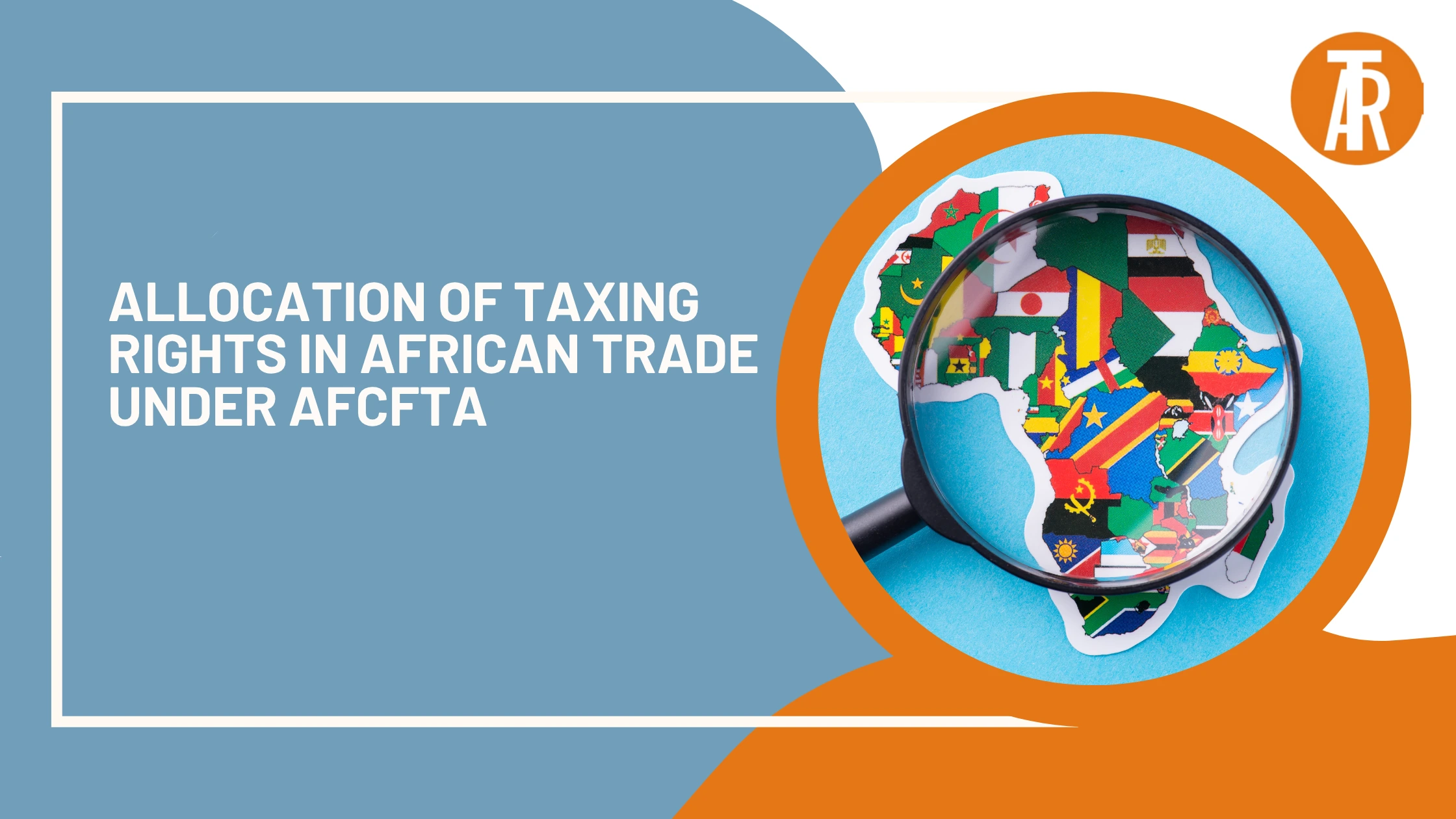
Allocation of Taxing Rights in African Trade under AfCFTA. The implementation of the African Continental Free Trade Area is fundamentally reshaping the geography of economic activity across Africa.
As goods, services, capital, and digital value flow more freely across borders, a central fiscal question becomes unavoidable:
Which country has the right to tax income generated from cross-border trade and investment within Africa?
This question—known as the allocation of taxing rights—lies at the core of international taxation and is critical to the success of a continental single market.
The Concept of Taxing Rights
Taxing rights refer to the authority of a country to:
- impose taxes on income, transactions, or value; and
- determine how much tax is due within its jurisdiction.
In cross-border trade, multiple countries may have legitimate claims to tax the same income based on:
- where the income is generated (source principle); and
- where the taxpayer is resident (residence principle).
Without clear rules, these overlapping claims create:
- double taxation;
- disputes between tax authorities; and
- uncertainty for businesses.
Why Allocation of Taxing Rights Matters under AfCFTA
AfCFTA promotes:
- increased intra-African trade;
- cross-border services;
- regional value chains;
- expansion of multinational African enterprises
However:
- tax systems remain fragmented;
- there is no unified continental tax framework;
- treaty coverage is limited.
Insight:
The absence of coordinated tax policies under AfCFTA creates significant challenges in determining taxing rights
Result:
- competing tax claims across jurisdictions.
Key Principles for Allocating Taxing Rights
Source Principle
Under the source principle:
- income is taxed where it is generated.
Examples:
- profits from business activities in a country;
- services performed within a country;
- income derived from local assets.
Favoured by:
- developing countries
- resource-based economies
Residence Principle
Under the residence principle:
- income is taxed where the taxpayer is resident.
Examples:
- global income of a company headquartered in a country.
Favoured by:
- capital-exporting countries
Destination Principle (Indirect Taxes)
For VAT:
- tax is imposed where consumption occurs.
Aligns with:
- trade neutrality
- cross-border consumption
READ ALSO: Royalty Payments and Taxation in ECOWAS Countries: What Nigerian Businesses Must Know
Key Challenges in Allocating Taxing Rights in Africa
Overlapping Tax Claims
Countries may simultaneously assert:
- source-based taxation;
- residence-based taxation.
Result:
- double taxation
Absence of Harmonised Rules
African countries:
- apply different tax principles
- use inconsistent definitions
Leads to:
- conflicting interpretations
Limited Double Tax Treaty Coverage
Without treaties:
- no clear allocation rules
- no relief mechanisms
Permanent Establishment (PE) Uncertainty
Different definitions of PE lead to:
- inconsistent recognition of taxable presence
Digital Economy Complexity
Digital businesses:
- generate income without physical presence
Raises questions:
- Should taxing rights be based on:
- user location?
- revenue source?
- economic presence?
Transfer Pricing and Profit Allocation
Multinational enterprises:
- allocate profits across jurisdictions
Risk:
- profit shifting
- base erosion
Sector-Specific Allocation Issues
Trade in Goods
- Source country: production or sale
- Destination country: consumption (VAT)
Services Trade
- Where service is performed
- Where service is consumed
- Where payment originates
Digital Services
- User location
- Revenue generation
- Platform presence
Investment Income
- Source country taxes dividends, interest, royalties
- Residence country taxes global income
Practical Illustration
A Nigerian company provides services to a South African client:
- Nigeria claims tax based on residence
- South Africa claims tax based on source
Without treaty:
- same income taxed twice
With clear allocation rules:
- taxing rights are shared or limited
Economic Implications
Reduced Investment
- Investors avoid uncertain tax environments
Increased Compliance Costs
- Businesses must navigate multiple tax systems
Distorted Trade Flows
- Tax considerations override efficiency
Revenue Losses
- Through:
- tax avoidance
- disputes
- inefficiencies
Policy Options for Africa
Develop an African Model Tax Framework
- Provide clear allocation rules
- Adapt global standards to African context
Expand Double Tax Treaty Network
- Reduce overlapping tax claims
- provide relief mechanisms
Harmonise Key Tax Concepts
- PE definitions
- VAT rules
- classification of income
Introduce Digital Nexus Rules
- Address taxation of digital businesses
Strengthen Transfer Pricing Systems
- Ensure fair allocation of profits
Enhance Regional Cooperation
- Information exchange
- joint audits
- dispute resolution
Strategic Implications
For Governments
- Must balance:
- revenue protection
- investment attractiveness
For Businesses
- Need clarity on:
- tax obligations
- risk exposure
For Investors
- Seek:
- predictability
- fairness
The Way Forward: Balanced Allocation Model
Africa should adopt a balanced allocation model that:
- protects source taxation rights;
- provides relief through residence taxation;
- incorporates digital economy considerations;
- aligns with AfCFTA objectives.
Conclusion
The allocation of taxing rights is one of the most critical issues in the implementation of AfCFTA. Without clear and coordinated rules:
- double taxation will increase;
- disputes will rise;
- investment will be discouraged.
To support a truly integrated African market, countries must:
- move toward coordinated tax frameworks;
- strengthen treaty networks;
- modernise tax rules.
Final Insight
Trade integration creates shared economic value.
Tax systems must decide how that value is shared.
For AfCFTA to succeed,
taxing rights must be allocated clearly, fairly, and consistently across Africa.